
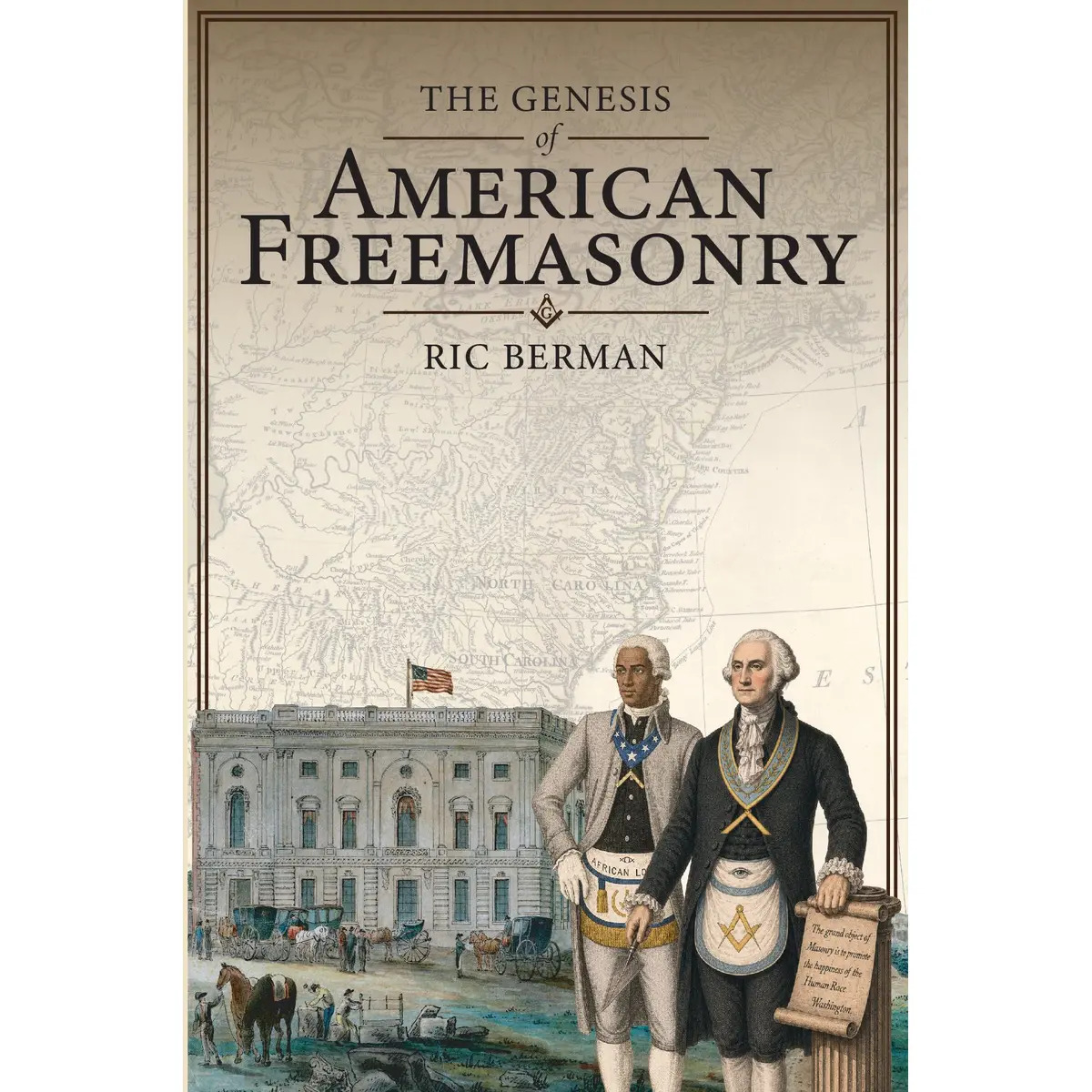
The Genesis of American Freemasonry
By Ric Berman
SKU: 9780853186991-
DESCRIPTION
Also Available As An Ebook Click Here
Most histories of American freemasonry focus on individual states or individuals, or where a broader sweep has been attempted, are often hagiographies. In contrast, The Genesis of American Freemasonry looks at the development of freemasonry in America and the evolution of its ritual within its contemporary eighteenth-century landscape using primary source material. It acknowledges how the thirteen colonies developed from being a component part of a transatlantic Greater Britain, a composite of America, Britain and Ireland, into an independent nation. It brings together the who and when with the why and how. And it acknowledges that many of the key Masonic figures had the same moral shortcomings as many of those who govern or influence society today.
The book explores how freemasonry altered over the eighteenth century and how this was part of a more widespread social and political transformation. It addresses slavery specifically as an institution that was integral to America's economic growth, and a fault line that impacted American Society. After providing a background to the development of freemasonry as an institution, it covers a time line that begins in the 1720s with the appointment of Americas first provincial grand masters, and examines the subsequent chartering of lodges and provincial grand lodges in Americas main trading centres from Philadelphia, Boston, Charleston, Savannah and New York, through to the creation of the new State Grand Lodges post-Independence.
The Genesis of American Freemasonry lays out how freemasonry expanded across the thirteen colonies and then pushed westward, crossing the Blue Ridge Mountains into Tennessee and Kentucky, and into Ohio and elsewhere. Integral to this story is migration, in particular, transatlantic Irish migration, a blend of London Irish and Ulster Irish, and internal migration, as freemasonry tracked the wagon trails of the American frontier, rolling west from the Atlantic east to the Great Plains.
The Genesis of American Freemasonry explains how American freemasonry derived principally from the Grand Lodge of England, adopting and promoting the 1723 Constitutions of Freemasons with its leading-edge Enlightenment precepts and principles, and mirroring and then adapting the different forms of Masonic ritual used in England; how it fused with Antients freemasonry, incorporating the latter's greater mutuality and accessibility; and how the combination became one of the seminal influences on the foundation of the new American Republic and the 1776 Declaration of Independence. In short, how freemasons and freemasonry helped lay the foundations of the city on a hill.
Masonic Enlightenment ideals a belief in religious and political tolerance, meritocracy, societal and self-improvement - and the governance practices of the lodge - elected officers and majority rule, with one-man one-vote, became part of America's constitutional development and provided a framework for federal and local government. At the same time, freemasonry enhanced social cohesion, especially on the frontier, where it provided a mutual support structure for its members that was both practical and spiritual.
Finally, The Genesis of American Freemasonry draws pen portraits of the men who led American freemasonry, setting out their successes and failures. Many provided weak leadership. Others, however, sometimes achieved remarkable success. This is their story.
Paperback (152 mm x 229 mm)
281 pages
-
THE AUTHOR
-
CUSTOMER REVIEWS